Altitude Adjustments: How Elevation Data Refines Betting Strategies Across Multiple Disciplines
Greta Neumann · Jun 21, 2026
Altitude Adjustments: How Elevation Data Refines Betting Strategies Across Multiple Disciplines
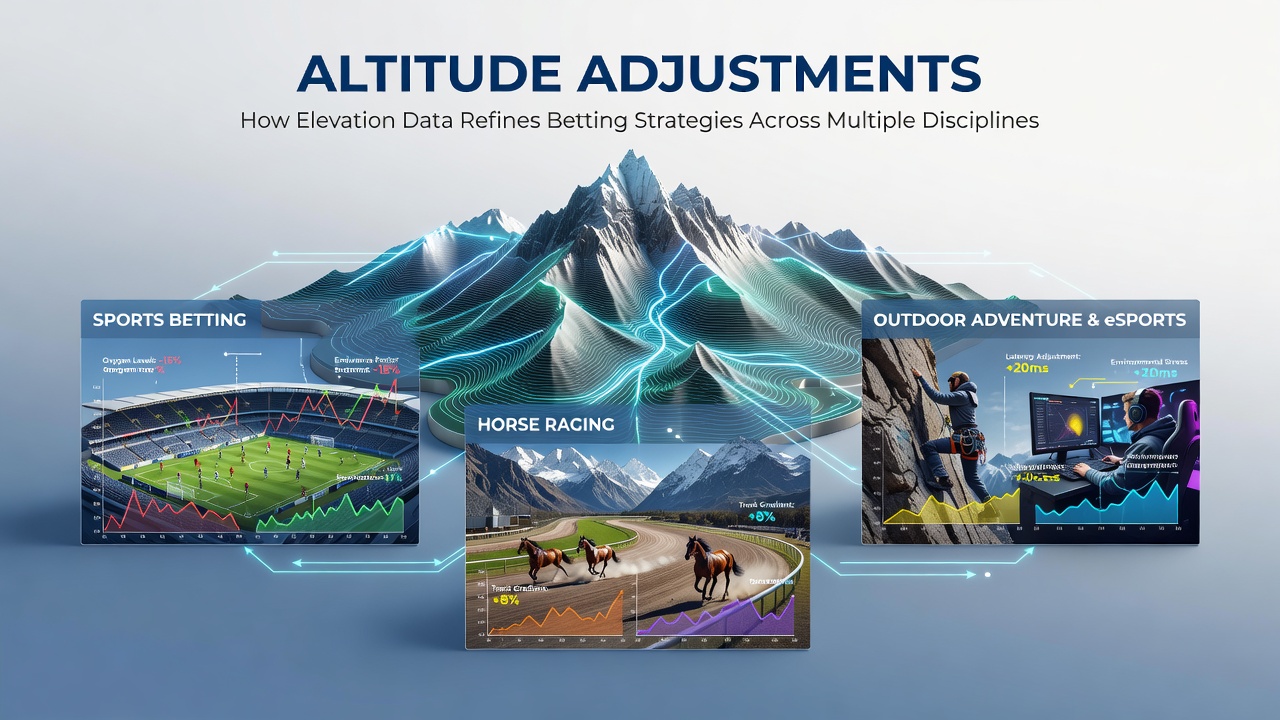
Altitude data has become a measurable factor in sports betting models because air density drops at higher elevations, which alters ball flight, player endurance, and recovery rates in measurable ways. Researchers at institutions such as the University of Colorado have quantified these effects through controlled performance trials, and the resulting datasets now feed into predictive algorithms used by professional syndicates and statistical services. Observers note that venues situated above 1,500 meters, including La Paz, Mexico City, and Johannesburg, consistently produce outcome distributions that deviate from sea-level baselines, and bookmakers adjust lines accordingly once elevation profiles enter the equation.
Football and Soccer: Oxygen Debt and Goal Timing
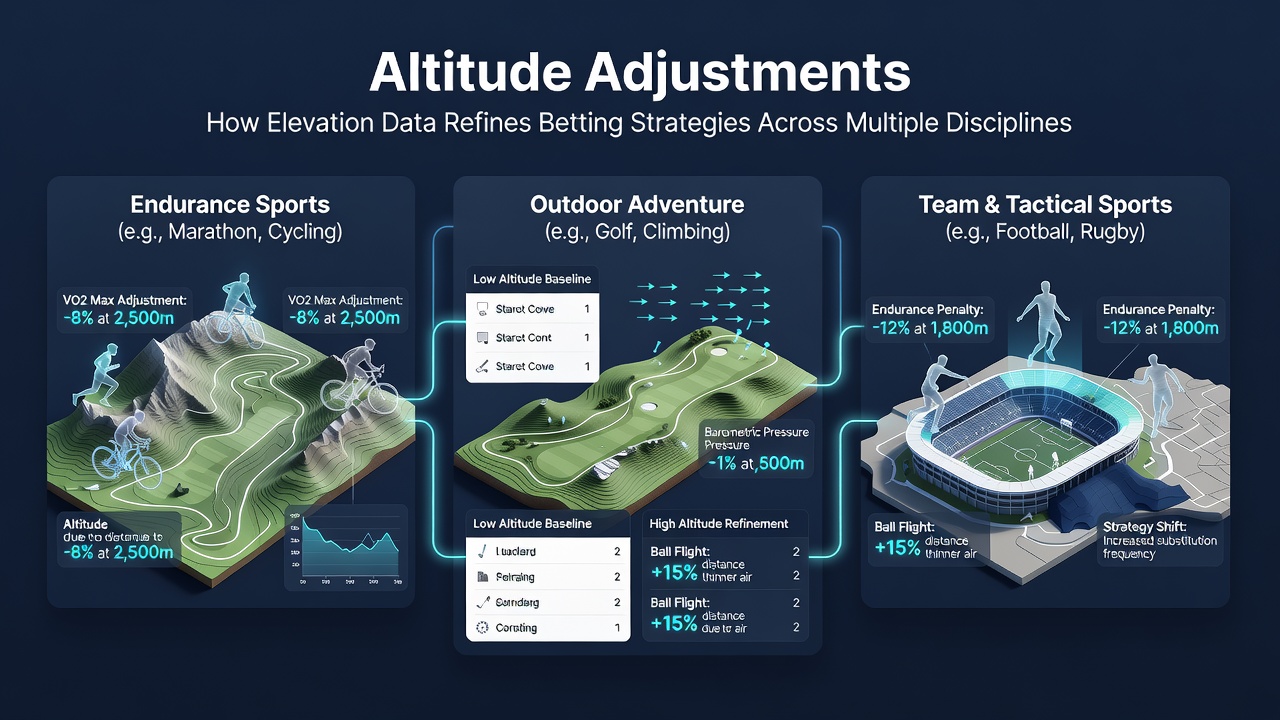
High-altitude stadiums compress match timelines because visiting teams experience reduced oxygen uptake during the first 30 minutes, while home squads maintain accustomed aerobic thresholds. Data compiled by the South American Football Confederation shows that teams traveling to La Paz record 18 percent fewer completed passes in opening halves compared with their season averages at lower elevations. Bettors who incorporate these figures into live models often target under totals on early goals or adjust handicap spreads when a sea-level side faces a acclimatized opponent. In June 2026, CONMEBOL published updated travel logs that included GPS-derived workload metrics, allowing sharper calibration of expected goal values for Copa Libertadores fixtures played above 2,800 meters.
Tennis and Court Speed at Elevation
Tennis ball trajectories change because thinner air reduces drag, which increases serve speeds and flattens bounce angles on hard courts. Studies conducted at the University of the Witwatersrand tracked ball velocities during tournaments in Johannesburg and found that first-serve speeds averaged 6.2 percent higher than identical player cohorts recorded at coastal events. Surface temperature and humidity interact with elevation, yet elevation alone accounts for a measurable portion of the variance. Professional syndicates therefore recalibrate over/under games and set statistics when matches occur at altitude, and they cross-reference these adjustments with historical head-to-head records from the same venues.
Horse Racing and Track Surfaces
Racing jurisdictions at elevation, such as certain tracks in the Andes and the South African highveld, present firmer going because lower humidity accelerates moisture evaporation from turf. Handicappers who integrate barometric pressure readings and soil-moisture indices have documented shifts in finishing times that reach 1.8 percent on sprint distances. Trainers report that horses with prior exposure to reduced oxygen environments recover faster between races, and those performance differentials appear in official form guides once syndicates aggregate veterinary and timing data. Bettors focusing on place markets therefore apply elevation multipliers derived from these records rather than relying solely on weight-for-age charts.
Golf and Carry Distance Modeling
Golf ball carry extends at altitude because reduced air density lowers resistance on the clubhead and the ball itself. The PGA Tour maintains elevation-adjusted distance charts for events at venues such as Mexico City and Johannesburg, where average driving distances increase between 8 and 12 meters compared with sea-level tournaments. Shot-link data released by the tour indicates that approach-shot proximity to the pin tightens on par-four holes when players benefit from extended carry, which in turn alters birdie-probability matrices used by betting exchanges. Market makers incorporate these distance increments when pricing hole-in-one specials and round-three leader markets, while syndicates refine their models by layering barometric forecasts released 48 hours before first tee times.
Integrating Multi-Source Datasets
Modern betting platforms merge elevation profiles with additional environmental layers, including temperature gradients, humidity, and wind vectors, to generate probability surfaces rather than single-point estimates. Reports from the Australian Institute of Sport demonstrate that combining GPS workload data with publicly available topographic maps improves the accuracy of endurance forecasts in team sports by roughly 9 percent over models that omit altitude. Canadian researchers have extended similar methods to winter disciplines, confirming that ski-jump and biathlon events at 1,800 meters produce time distributions that require separate variance parameters. These layered approaches allow operators to publish dynamic odds that respond to real-time meteorological updates, and they reduce the edge once held by local bookmakers who relied on anecdotal course knowledge.
Regulatory and Data-Access Developments
Transparency initiatives by sports governing bodies have increased the availability of granular performance files. In early 2026 the International Olympic Committee expanded its open-data portal to include altitude-tagged training logs from national federations, enabling independent analysts to test elevation hypotheses across additional disciplines. European betting operators now reference these files when constructing in-play models for summer and winter Olympic qualifiers, and they disclose the elevation component within their published risk parameters to satisfy licensing conditions set by the Malta Gaming Authority. Such disclosures have encouraged wider adoption of elevation adjustments among retail bettors who previously lacked access to the underlying datasets.
Conclusion
Elevation data has moved from niche environmental detail to core input in quantitative betting frameworks across football, tennis, horse racing, and golf. As governing bodies release higher-resolution performance files and meteorological services refine localized forecasts, models that omit altitude adjustments increasingly lag behind those that integrate them. The pattern holds across regions and surfaces because the physical mechanisms remain consistent even while the specific numerical impacts vary by sport and venue.