High-Altitude Football Venues and Their Influence on Live Betting Markets
Mara Koch · Jun 26, 2026

High-Altitude Football Venues and Their Influence on Live Betting Markets
Football matches played at elevations above 2,500 meters create measurable differences in player performance that betting markets track closely, and live odds shift accordingly as the game unfolds. Venues such as those in La Paz, Quito, and Bogotá force rapid physiological adjustments including reduced oxygen uptake and increased heart rates, which alter sprint distances, passing accuracy, and overall work rate within the first fifteen minutes. Bookmakers monitor these patterns through real-time data feeds that incorporate player tracking metrics, allowing them to recalibrate probabilities for goals, corners, and cards as fatigue sets in unevenly across both teams.
Physiological Data Driving Market Reactions
Studies conducted by the University of Colorado's Altitude Research Center show that players unacclimatized to heights around 3,600 meters experience a 15 to 20 percent drop in repeated sprint ability after thirty minutes of play, while local squads maintain steadier output through gradual adaptation. This disparity appears in match statistics released by CONMEBOL during the 2025 Copa Libertadores campaign, where visiting sides recorded lower total distance covered and fewer high-intensity runs in the second half. Betting operators integrate these benchmarks into algorithms that widen or narrow spreads on total goals and half-time results the moment a team from sea level begins to slow visibly on the pitch.
Live odds platforms adjust prices in increments as small as 0.05 decimal points when sensors detect elevated breathing rates or reduced acceleration data from players who started the match at full intensity. In June 2026 several South American qualifiers featured extended stoppage time at high venues because medical staff responded more frequently to cramp and dizziness, extending the window for in-play wagers on late goals or disciplinary actions.
Regional Patterns and Historical Benchmarks
Matches in the Bolivian Primera División have produced lower average goal tallies at home grounds above 3,000 meters compared with lowland fixtures, according to aggregated figures compiled by Opta across the past decade. Visiting teams from coastal regions concede more set-piece opportunities after the sixtieth minute when oxygen debt compounds coordination errors. These recurring trends allow traders to price opening lines that already embed a home-side edge, yet further corrections occur once the opening exchanges confirm whether the away squad has prepared with pre-match altitude camps.
European clubs traveling to similar elevations for continental ties encounter comparable challenges, and scouting reports circulated among betting syndicates now include acclimatization schedules alongside tactical analysis. When a squad arrives only forty-eight hours before kickoff the probability models shift toward under goals and higher card counts because recovery between bursts of play lengthens measurably.
Live Odds Mechanics at Elevation
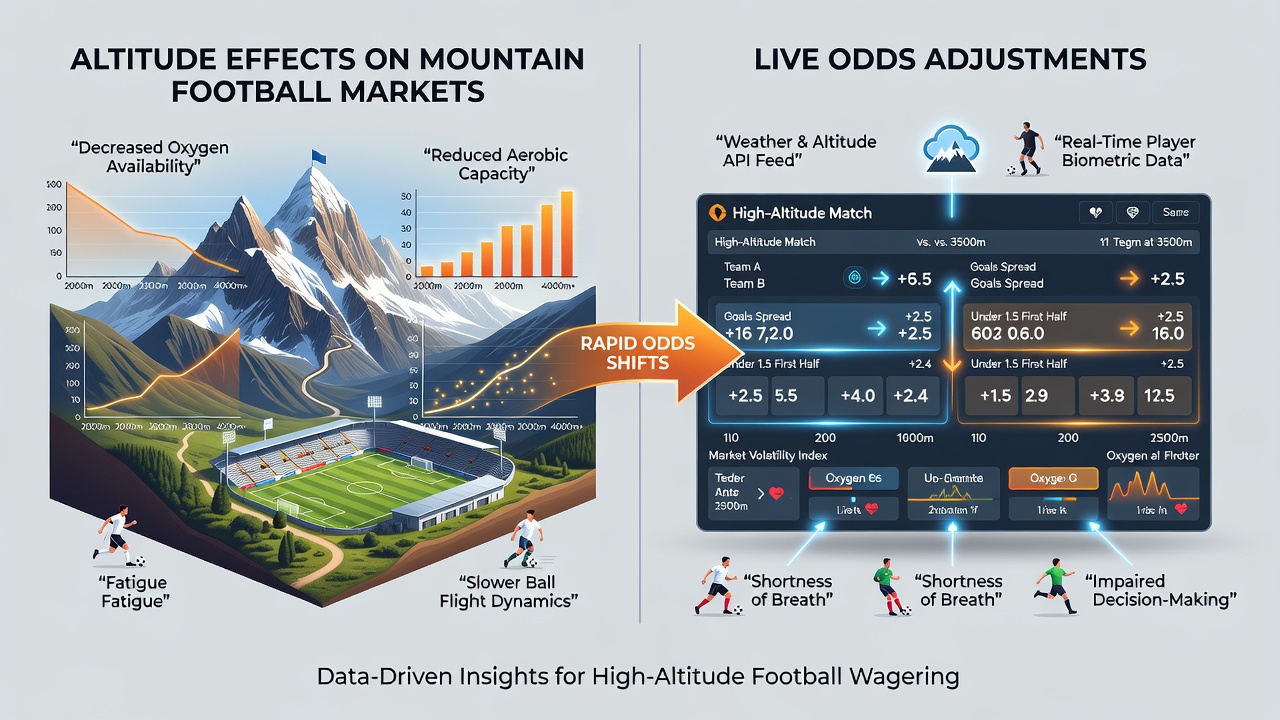
Automated systems employed by major exchanges pull from multiple data streams including GPS wearables, heart-rate monitors, and video-based event tagging to recalculate implied probabilities every few seconds. A sudden cluster of incomplete passes or defensive lapses triggers immediate repricing on next-goal markets, and these movements often accelerate once the ball spends longer periods in one half because the trailing side pushes forward while carrying greater fatigue. Observers note that liquidity sometimes thins on over/under lines after the seventieth minute at these venues because sharp bettors wait for clearer signals of physical decline before committing additional stakes.
Regulatory frameworks outside the UK, such as those overseen by the Malta Gaming Authority and the Australian Communications and Media Authority, require operators to maintain transparent audit trails for any algorithmic adjustments tied to environmental factors. This oversight ensures that altitude-driven changes remain grounded in verifiable performance data rather than discretionary intervention.
Future Data Integration and Tournament Implications
Upcoming confederation events scheduled for mid-2026 will expand the use of portable lactate analyzers and continuous oxygen-saturation readings that feed directly into broadcast graphics and, by extension, into the same data pipelines used by odds compilers. Early trials conducted during the 2025 Bolivian national team friendlies already demonstrated that real-time physiological overlays correlate strongly with spikes in live-betting volume on both team totals and individual player props. As these tools become standard, markets at lower-altitude venues may begin incorporating baseline comparisons to isolate the unique contribution of elevation when the same squads meet again at sea level.
Conclusion
Altitude remains a quantifiable variable that shapes both on-field outcomes and the speed at which live football markets respond. Data from physiological research, match-tracking providers, and regulatory reporting bodies continue to refine how operators price and adjust odds when matches unfold above 2,500 meters, creating a feedback loop between athletic performance metrics and wagering activity that grows more precise with each passing season.