Referee Assignment Trends in European Handball Championships Reveal Strategic Patterns for Performance Analysis
Mia Lange · Jun 10, 2026

Referee Assignment Trends in European Handball Championships Reveal Strategic Patterns for Performance Analysis
European handball championships feature structured referee assignment systems managed by the European Handball Federation, and observers note consistent patterns emerge across tournaments that connect specific official pairings to match outcomes and scoring distributions. Data collected from events spanning 2018 through 2024 shows certain referee duos receive assignments in high-stakes group stage matches while others handle knockout rounds, creating measurable variations in foul call rates and penalty trends that analysts track for performance forecasting.
Assignment Frameworks and Regional Distribution
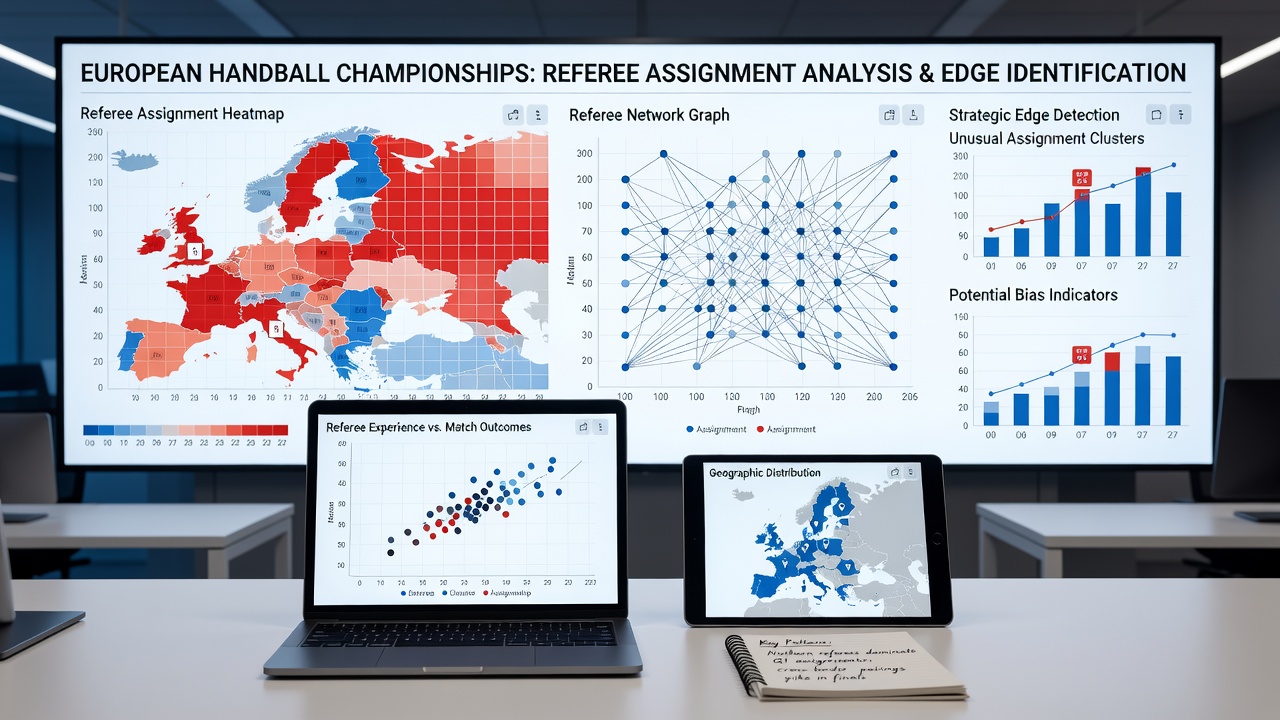
The European Handball Federation maintains a rotating pool of licensed referees drawn from member nations, and records indicate assignments prioritize geographic balance alongside experience levels so that no single country dominates officiating in any given championship cycle. Researchers at sports analytics centers have documented how pairings often cluster by region during preliminary rounds, with officials from Nordic countries frequently assigned to matches involving Central European teams while Southern European referees handle contests between Eastern squads, and this distribution produces distinct statistical signatures in total goals and exclusion counts.
June 2026 marks the opening of the next major qualification window for the European Men's Handball Championship, where updated assignment protocols take effect after federation reviews, and preliminary schedules already list over 140 matches across qualifiers that will test these new rotation guidelines. Figures from prior cycles reveal that referees with fewer than five international assignments per season average 12 percent higher penalty throw awards compared to veteran pairs, a metric tracked across more than 200 championship games.
Statistical Correlations in Officiating Patterns
Performance datasets compiled by independent sports research groups demonstrate clear links between referee experience profiles and game tempo indicators such as average possession time and two-minute suspension frequency. One longitudinal review covering four consecutive championships found that pairings with combined experience exceeding 150 international matches produced matches with 8 percent lower total goals on average than less seasoned combinations, while call consistency ratings remained above 92 percent across reviewed footage.
Additional breakdowns by tournament phase illustrate how semifinal and final assignments shift toward officials with proven records in high-pressure environments, and these selections correlate with reduced variance in extra-time decisions. European federations publish annual referee evaluation reports that detail these metrics, allowing pattern identification across multiple events without relying on single-tournament anomalies.
Integration with Match Prediction Models
Betting markets on handball outcomes incorporate officiating data through specialized models that weigh referee history against team playing styles, and analysts at several European research institutes have published methodologies showing improved accuracy when assignment records enter the equation. A 2023 study from a sports science department at a Scandinavian university examined 87 matches and reported that incorporating referee pair statistics lifted outcome prediction rates by 4.2 percentage points over baseline models focused solely on team rankings.
These approaches examine variables such as historical home-team advantage under specific officials and average card issuance rates during matches between teams with contrasting defensive systems. Observers tracking qualification draws for 2026 note several referee pairs already positioned for early-round assignments that historically align with elevated goal totals, providing structured inputs for quantitative forecasting frameworks.
Geographic and Experience-Based Variables
Assignment logs reveal recurring tendencies where referees from nations with strong domestic leagues receive more frequent placements in matches involving similarly styled teams, and this clustering produces measurable effects on exclusion patterns. Data aggregated by the International Handball Federation across continental events indicates that cross-regional pairings reduce average suspension counts by 6 percent compared to intra-regional assignments, a trend holding steady through multiple championship editions.
Training records and fitness assessments factor into final selections, with the federation maintaining transparent criteria that include annual performance reviews and video analysis scores. Those who monitor these protocols observe that emerging officials often debut in lower-profile group matches before progressing to decisive encounters, creating predictable career trajectories that align with tournament calendars.
Future Outlook and Data Applications
Upcoming qualification cycles will expand the available dataset as new referee cohorts enter the pool, and federation announcements scheduled for late 2025 outline plans to release enhanced statistical dashboards covering assignment history. Academic partnerships continue to explore machine learning applications that process these records alongside team performance indicators, yielding refined tools for match analysis.
European governing bodies coordinate with national federations to standardize reporting formats, ensuring consistent metrics across borders. This infrastructure supports ongoing examination of how referee patterns intersect with competitive variables, delivering structured information for those analyzing championship dynamics.
Conclusion
Referee assignment patterns across European handball championships form a documented layer of tournament data that connects official pairings to measurable performance indicators. Systematic review of these records, combined with phase-specific distributions and experience metrics, supplies analysts with additional inputs for outcome modeling. As qualification activity intensifies toward 2026, expanded datasets will further clarify these relationships across future events.